Commodore 64
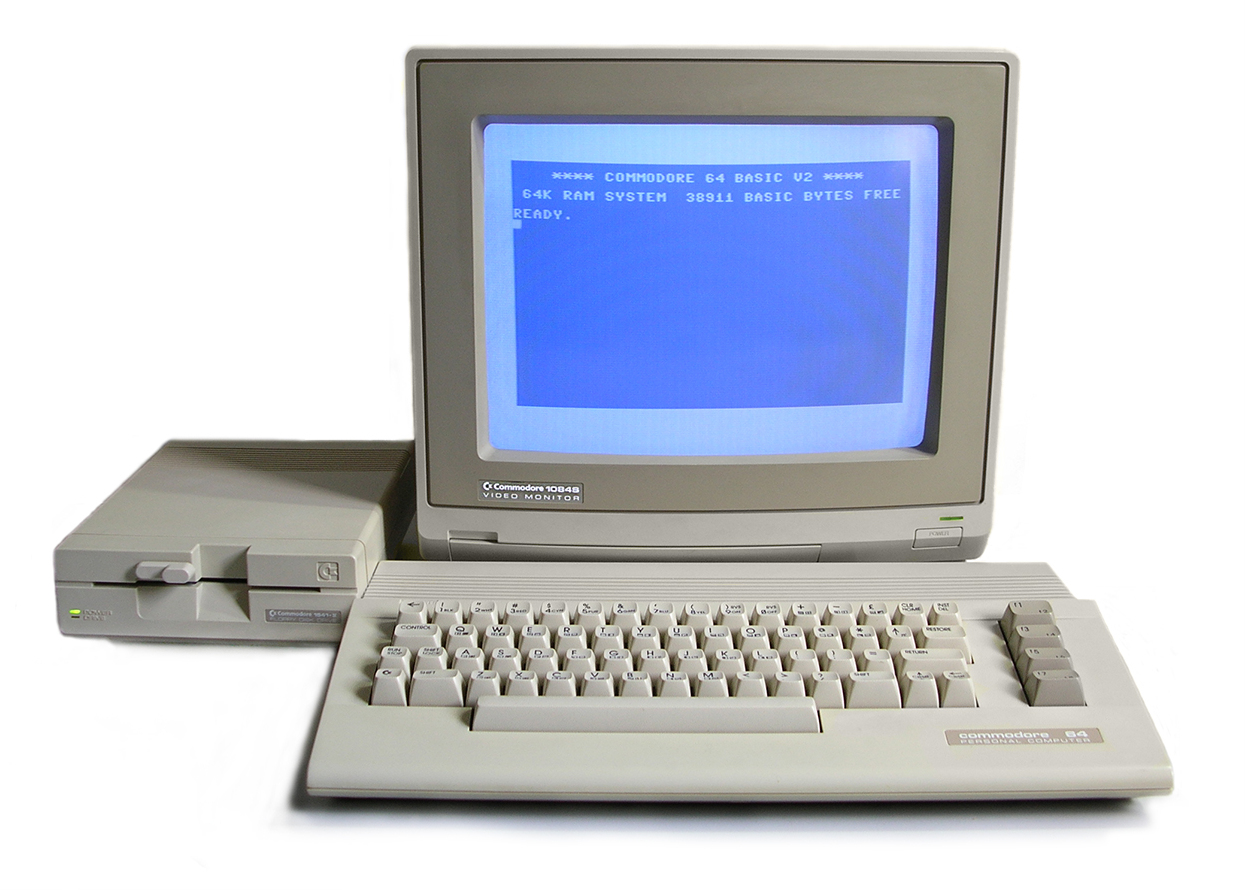
Commodore 64C system photo: Bill Bertram, CC BY-SA 2.5, via Wikimedia Commons.
Commodore released the C64 in August 1982, undercutting nearly everything else on the market by selling a machine with genuinely impressive graphics and sound hardware — the VIC-II video chip and SID sound chip — through department stores and discount retailers rather than computer shops alone. It went on to become the best-selling single computer model of all time, and that scale, combined with the VIC-II's own particular quirks and limitations, produced an enormous, fiercely competitive ecosystem of paint programs, each pushing the same fixed hardware a little further than the last.
Commodore 64 File Formats
Nearly every format below is a direct dump of the VIC-II chip's own framebuffer: an 8,000-byte bitmap organized as 40×25 character cells, plus one or two 1,000-byte "screen RAM" and "color RAM" tables supplying each cell's colors, plus (in multicolor mode) a single global background byte. Different art programs simply arranged those same pieces at different offsets in the file — which is why dozens of distinct "formats" below are all, underneath, the same handful of hardware facts read at a different address. What's below is what survives of that decade of C64-native paint software: still opened today by demoscene artists, emulator users, and retro-computing archivists.
Formats on This Page
| Format | Extension | Kind | Introduced |
|---|---|---|---|
| Koala Paint | .koa, .kla, .gg | Multicolor bitmap | 1983 |
| Doodle! | .dd, .doo, .jj | Hires bitmap | 1983 |
| FLI, AFLI, and the interlace tricks | .fli, .bml, .bfli, .afl, .him, .hfc, .hed, .ihe, .ffli, .gun, .fun | Hi-color & truecolor bitmap | 1985 / 1989 |
| OCP Art Studio | .ocp, .art, .a64, .aas | Hires & multicolor bitmap | 1985 / 1987 |
| Blazing Paddles | .pi | Multicolor bitmap | 1984 |
| Amica Paint | .ami | Multicolor bitmap | 1988 |
Koala Paint
Koala Paint is the Commodore 64's most iconic paint program, and its file layout — an essentially untransformed dump of the VIC-II's multicolor framebuffer — became the platform's de facto standard interchange format for multicolor art.
| Aspect | Detail |
|---|---|
| Developer | Audio Light, Inc. (Los Gatos, California) |
| Publisher | Koala Technologies Corporation |
| Released | 1983, alongside the KoalaPad graphics tablet |
| Bundled hardware | The KoalaPad — a small touch tablet, designed by Dr. David Thornburg, connected through the joystick port |
| Extensions | .koa, .kla (raw); .gg (RLE-compressed, escape byte 0xFE) |
History
Koala Technologies Corporation released the KoalaPad touch tablet in 1983, aimed
squarely at schools as a low-cost alternative to a mouse, and bundled it with paint
software — KoalaPainter on the C64, developed for Koala by Audio Light, Inc., under
matching names on the Apple II, Atari 8-bit, IBM PC, and TRS-80 Color Computer. The
Atari 8-bit edition, MicroIllustrator, was a
separate development by Island Graphics rather than a port of Audio Light's C64 code. The C64
version saves the VIC-II's 320×200 multicolor framebuffer essentially as-is: an 8,000-byte
bitmap, a 1,000-byte screen RAM table, a 1,000-byte color RAM table, and one background
byte, either raw or RLE-compressed behind an 0xFE escape byte (commonly seen
with the .gg extension).
Legacy and Popularity Today
That direct, untransformed layout is likely a real part of why Koala format became the C64's standard multicolor interchange format: any program could read or write one with a simple memory dump, no format-specific decoding required. It remains the format C64 demoscene artists are asked to deliver finished multicolor pieces in today, and current tools including Multipaint, RetroConvert, and png2prg all read and write it, alongside continued use in emulators like VICE for verification.
Paintapp Support
Paintapp decodes both raw Koala framebuffers (with or without the 2-byte PRG load
address) and RLE-compressed .gg files, unpacking the 0xFE-escaped
stream before decoding the standard multicolor layout.
Links
Doodle!
Doodle! is the hires-mode counterpart to Koala Paint's multicolor dominance — where Koala became the standard for 4-color-per-cell multicolor pictures, Doodle became the standard for sharper, 2-color-per-cell hires pictures.
| Aspect | Detail |
|---|---|
| Publisher | City Software (Milwaukee, Wisconsin) |
| Released | 1983 |
| Compressed variant | Files with the .jj extension are RLE-compressed Doodle pictures — a naming convention parallel to Koala's own .gg, not a separate program |
| Extensions | .dd, .doo (raw); .jj (RLE-compressed) |
History
City Software published Doodle! in 1983, saving the VIC-II's 320×200 hires framebuffer — an 8,000-byte 1-bit-per-pixel bitmap plus a 1,000-byte screen RAM table giving each 8×8 cell two of the C64's 16 colors. Contemporary advertising called it "the finest art program for its price"; modern retrospective opinion is more mixed, with some users recalling a steeper learning curve than the marketing suggested. Alongside Koala Paint, it's repeatedly named among the small handful of programs C64 owners actually reached for, split cleanly along the hardware's own hires/multicolor line.
Legacy and Popularity Today
Doodle and Koala are still named together as the two de facto standard C64 picture formats for their respective modes. Modern conversion tools including Pixcen and GoDot read and write Doodle files; as with most C64 picture formats, viewing support lives in dedicated converters and viewers rather than in emulators like VICE directly.
Paintapp Support
Paintapp decodes raw Doodle hires pictures and the RLE-compressed .jj
variant, unpacking its Koala-style 0xFE-escaped stream before decoding the
standard hires layout.
Links
FLI, AFLI, and the Interlace Tricks
FLI (Flexible Line Interpretation) is the C64 demoscene's signature color hack: normally the VIC-II reloads each 8×8 cell's two colors once every 8 scanlines, but FLI reprograms the chip's memory-bank-select register on every single scanline instead, giving every row of every cell its own pair of colors — an eightfold jump in color resolution, at the cost of exacting, cycle-timed code.
| Aspect | Detail |
|---|---|
| Discovered | The demoscene, not a commercial program — first seen in "So-phisticated III" (Black Mail / 20th Century Composers / Inorix), 15 July 1989 |
| The "FLI bug" | The trick corrupts the leftmost 3 character columns (24 pixels) of the display, which is why FLI images are 296 pixels wide rather than a clean 320 |
| AFLI (Advanced FLI) | The same per-scanline reload applied to hires mode instead of multicolor mode; dated to around April 1990 |
| Interlace variants | FFLI, Gunpaint, and FunPaint II further blend two FLI fields flickered at 50Hz into truecolor, the same "flicker fusion" idea used elsewhere on this page and on the ZX Spectrum's Gigascreen; BFLI instead stacks two fields into one tall image without blending |
| Related program: Hi-Eddi | A plain hires paint program by Hans Haberl, published in German magazine 64'er, January 1985 — written, per Haberl, so a friend could draw Chinese characters on a C64. Its file format later gained an AFLI hi-color save mode (.him) and an interlaced truecolor mode (.ihe) alongside its original plain hires mode (.hed) |
| Extensions | .fli (FLI/FLM); .bml (FLI "bars"); .bfli (stacked, unblended); .afl (AFLI Editor); .him (Hi-Eddi AFLI); .hfc (HiFli, another AFLI variant); .hed (Hi-Eddi plain hires); .ihe (Interlace Hi-Eddi); .ffli (interlaced FLI bars); .gun (Gunpaint); .fun (FunPaint / FunPaint II) |
History
Unlike most of the paint programs on this page, FLI has no company or product behind it — it's a hardware side effect the demoscene found and exploited. "So-phisticated III," a 1989 demo, is the earliest documented use, and its "FLI upscroller" reportedly sent other demo groups scrambling to reverse-engineer the trick afterward. The corruption along the screen's left edge — the "FLI bug" — comes from the VIC-II reading garbage data when its memory bank is switched mid-frame rather than once per frame as designed; no source credits a single discoverer for it, only the demo that first showed it off. AFLI, applying the same idea to hires mode, followed roughly a year later; the interlaced/truecolor variants (FFLI, Gunpaint, FunPaint II) and the tall, unblended BFLI layout are further refinements from the same demoscene tradition, none of them tied to a named individual in the sources checked for this page.
Hi-Eddi predates FLI by several years and isn't itself a color hack — Hans Haberl wrote it as a plain hires drawing program, printed as a type-in listing in 64'er magazine in January 1985, later expanded into a book, "Mini-CAD mit Hi-Eddi plus." Its format family grew an AFLI hi-color mode and an interlaced truecolor mode alongside the original, which is why all three live in this one section rather than beside Doodle and Koala.
Legacy and Popularity Today
FLI and its variants remain central to C64 demoscene graphics; VICE's cycle-accurate
VIC-II emulation (its x64sc mode) is specifically what makes correct
FLI/AFLI playback possible in emulation at all, since the trick depends on exact chip
timing. The Windows pixel editor Pixcen explicitly supports both hires and multicolor FLI
modes for creating new FLI art today, and demos built entirely to showcase historic FLI
and IFLI images — like Crest's 2010 "Crest Slide Story," which also introduced a newer
flicker-free successor mode called NUFLI — are themselves part of the format's ongoing
life in the scene.
Paintapp Support
Paintapp decodes the full FLI family as indexed images (plain FLI/FLM, BML, AFLI via the
AFLI Editor, Hi-Eddi's .him, and the smaller HiFli .hfc, plus
the stacked 296×400 BFLI), and the interlaced truecolor variants — FFLI, Gunpaint,
FunPaint/FunPaint II, and Hi-Eddi's own interlaced .ihe — by decoding both
fields and blending them the same way the real hardware's 50Hz flicker does.
Links
- Commodore 64 demos — Wikipedia
- Graphics Modes — C64-Wiki
- Hi-Eddi — Wikipedia (German)
- So-Phisticated III — CSDb
OCP Art Studio
OCP Art Studio was a genuine cross-platform release rather than separately-branded lookalikes — one program, ported by different programmers to each 8-bit machine of its era, the C64 among them.
| Aspect | Detail |
|---|---|
| Developer | Oxford Computer Publishing (original ZX Spectrum version by James Hutchby, 1985); ported to C64, Amstrad CPC, and later Atari ST by other named programmers per platform |
| Publisher | Rainbird, across every platform |
| C64 released | 1986 |
| Advanced Art Studio released | 1987 — a successor adding refinements across platforms, reviewed at 78% by Zzap!64 |
| Save modes | A plain hires mode (.art) and the program's own multicolor mode (.ocp); Advanced Art Studio adds its own hires (.aas) and multicolor (.a64, $4000 load address) variants |
| Extensions | .ocp, .vic (multicolor); .art (hires); .a64 (Advanced Art Studio multicolor); .aas (Advanced Art Studio hires) |
History
James Hutchby wrote the original Art Studio for the ZX Spectrum, published by Oxford Computer Publishing under the Rainbird label in 1985; ports to the Commodore 64 and Amstrad CPC followed under the same publisher and design lineage, saving both a hires mode and the VIC-II's native multicolor mode. Rainbird followed with Advanced Art Studio in 1987, ported per-platform by different named programmers — Dimitri Koveos for the Spectrum 128K/+2 version, Chris Hinsley for the later Atari ST port — refining the original across every machine it reached.
Legacy and Popularity Today
Art Studio and Advanced Art Studio are still named alongside Koala Paint and Doodle as among the C64's most-used art programs, and the format remains supported by current conversion tools — Tom's Editor, an online image converter, lists "Advanced Art Studio (.OCP)" as a direct export target, and C64 scene tools like AUTOGRAPH read the plain format as well.
Paintapp Support
Paintapp decodes both OCP Art Studio save modes — the multicolor layout
(.ocp/.vic) and the plain hires layout (.art) — and
both Advanced Art Studio variants, its $4000-load multicolor mode
(.a64) and its hires mode (.aas).
Links
- OCP Art Studio — Wikipedia
- The OCP Advanced Art Studio review, Zzap!64 #30 — Everygamegoing
- Convert image to Advanced Art Studio (.OCP) — Tom's Editor
Blazing Paddles
Blazing Paddles was a genuine cross-platform release too — the same product, sold with a shared manual plus a platform-specific supplement, on both the Commodore 64 and the Atari 8-bit family.
| Aspect | Detail |
|---|---|
| Developer (C64/Apple II) | David Walker, for Baudville |
| Developer (Atari 8-bit port) | Joe Hellesen |
| Publisher | Baudville (Grand Rapids, Michigan) |
| Released | 1984 (C64/Apple II); Atari 8-bit port, 1986 |
| Input | Paddle controllers, alongside joystick, mouse, graphics tablet, and light pen support |
| Extensions | .pi, embeddable in a .vic container |
History
Baudville published Blazing Paddles in 1984 for the Commodore 64 and Apple II, programmed by David Walker; an Atari 8-bit port followed in 1986, credited to Joe Hellesen and sold with the same core manual plus a short Atari-specific supplement rather than a separate rewritten one — real evidence this was one product ported across platforms, not just a reused name. A contemporary Creative Computing review called it fast and easy to use, comparing it to bringing MacPaint-like drawing to 8-bit hardware, while noting its cut/paste tool couldn't fully delete due to running out of memory once the feature was added.
Legacy and Popularity Today
Blazing Paddles is remembered more modestly today than Koala Paint or Advanced Art Studio in retrospective C64 community discussion, but its multicolor format remains supported by dedicated conversion tools like AUTOGRAPH.
Paintapp Support
Paintapp decodes Blazing Paddles' multicolor layout, both as a raw .pi file
and embedded in a .vic container.
Links
- Blazing Paddles review — Creative Computing, Vol. 11 No. 8
- Blazing Paddles disk image — Internet Archive
- Blazing Paddles (Atari 8-bit) — Atari Mania
- Blazing Paddles — Atari 8-bit platform details, for the Joe Hellesen port's own
.chr/.shpformats
Amica Paint
Amica Paint stands apart from the rest of this page's commercial releases: it began life as a magazine type-in listing rather than boxed software, and its author built real anti-tampering protection directly into the code.
| Aspect | Detail |
|---|---|
| Developer | Oliver Stiller |
| First published | 64'er magazine, special issue 27, 1988 — a 25-page type-in program listing |
| Re-released | Special issue 55, 1990, on floppy disk |
| Compressed variant | .ami files are DrpStream-RLE-compressed (escape byte 0xC2) behind a 2-byte load address |
| Extensions | .ami |
History
Oliver Stiller wrote Amica Paint and published it as a type-in listing in 64'er special issue 27 in 1988 — the credits message embedded in the program reads "BY O.STILLER 1986/87," suggesting the software itself was finished a year or two before it saw print. Stiller protected that credit with a checksum: if the message was altered, the program would silently corrupt its own line-drawing routine. When 64'er republished the program on floppy disk in special issue 55 two years later, an editor updated the visible date to "1990" without adjusting the code underneath — tripping Stiller's own protection and shipping a version where drawing a simple line caused severe glitches. The magazine had to publish a follow-up patch, in effect admitting the "new" release wasn't the clean rewrite it appeared to be.
Legacy and Popularity Today
Amica Paint is named alongside Koala Paint, (Advanced) Art Studio, and Doodle as one of the programs C64 owners actually used and still discuss today, and its multicolor format remains readable by current tools.
Paintapp Support
Paintapp unpacks Amica Paint's DrpStream-compressed picture data into a standard Koala-style multicolor framebuffer before decoding it.
Links
- How Amica Paint protected tampering with its credits — pagetable.com
- Amica Paint — C64-Wiki (German)
Related Commodore 8-bit Hardware
Two other Commodore 8-bit machines each have exactly one picture format in Paintapp's registry — too little for a page of their own, but real enough to note here.
Commodore 128
The C128, Commodore's last 8-bit computer, shipped in 1985 (hardware design led by Bil
Herd) and sold roughly 2.5 million units before discontinuation in 1989. Alongside the
VIC-II it shares with the C64 for compatibility mode, it adds a second video chip, the MOS
8563 "VDC," driving an 80-column display with its own separate video memory. The
.vbm format Paintapp reads (a monochrome bitmap dumped from that VDC memory,
in two versions with optional RLE compression) isn't tied to a named commercial paint
program — it traces instead to Craig Bruce's ACE, a Unix-shell-like alternative
environment for the C64/128, and the small viewer/converter toolset built around it.
Commodore 16 / Plus 4
The Commodore Plus/4 and its cheaper sibling the C16 (the "264 series") launched in 1984,
designed by much the same hardware team that went on to build the C128. They sold poorly
and were discontinued within about a year — undermined by incompatibility with the C64's
huge software library, dropped sprite hardware, and a weak bundled office suite. Their TED
video chip trades the C64's fixed 16 colors for a 4-bit-hue/3-bit-luminance model reaching
121 distinct colors, at lower overall capability otherwise. The .p4i format
Paintapp reads comes from Botticelli, a 1987 commercial paint program for the Plus/4 by
the Hungarian studio Octasoft (coders György Szöllősi, Tibor Kerekes, and Károly Jónás),
published by Novotrade Magyarország, with a sequel, Multi Botticelli, following in 1988.
Other Commodore 8-bit Formats Paintapp Reads
A large number of smaller C64 art packages round out Paintapp's support — most from the same VIC-II multicolor or hires mold as the programs above, narrower in scope or popularity, but real:
| Format | What it is | Paintapp support |
|---|---|---|
DrazPaint / DrazLace | A multicolor paint program (1994) and its interlaced-truecolor companion, by "Devil" of the Swedish group Noice | Decoded |
GoDot | A modular C64-native image conversion and IFLI-slideshow tool by Arndt Dettke, storing pictures as brightness-ordered nibbles | Decoded |
Picasso 64 | A multicolor paint program | Decoded |
Rainbow Painter | A multicolor paint program with no stored background color | Decoded |
InterPaint | A paint program with both hires and multicolor save modes | Decoded |
Logo Painter 3 | A 320×400 char-indexed 4-color drawing format | Decoded |
Image System | A multicolor picture format | Decoded |
C64 Character Set | A font/charset file, viewable as a glyph-grid bitmap | Decoded |
| CDU-Paint, Face Painter, FunGraphic System, Gigapaint, Micro Illustrator, Paint Magic, Run Paint, Saracen Paint, Vidcom 64 | A further nine minor C64 multicolor art packages, each using its own memory layout of the same VIC-II framebuffer | Decoded |
SPD | A sprite sheet from SpritePad, a modern (2003–) Windows sprite/tile editor for the C64 | Decoded |
FLUFF64 | A cross-platform (C64/VIC-20/Amiga/CGA/ST/Amstrad/BBC/ZX) picture container from the modern Fluff64 editor, since merged into the TRSE C64 development toolchain | Decoded |
| GCD, GIH, MON, HLF, generic hires, ECI/ECP, MLE | A further handful of plain or interlaced hires bitmap conventions with no named authoring program found | Decoded |
See Also
- File Formats — the complete format registry, with a "Browse by Platform" section covering Commodore 64 alongside every other supported platform
- ZX Spectrum — Gigascreen, the flicker-fusion truecolor trick most similar to the FLI family's interlaced variants