Apple II & IIgs
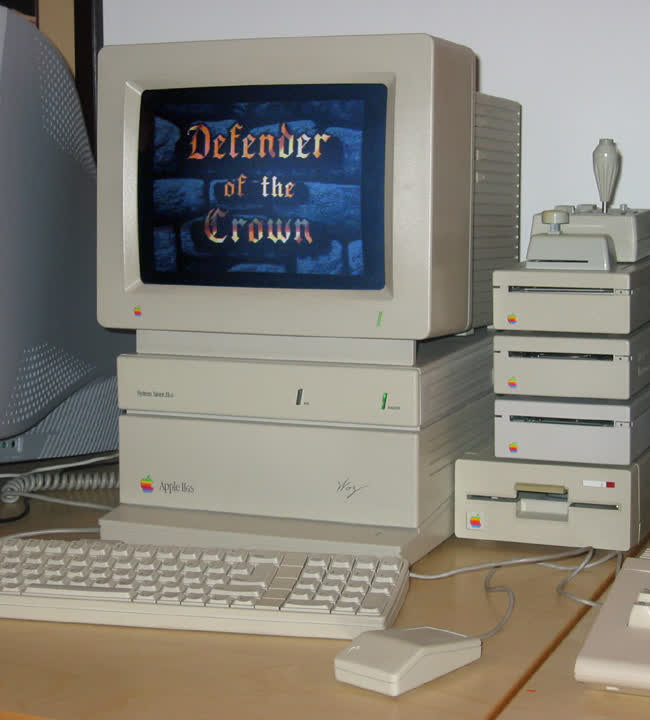
Apple IIgs system photo: Blake Patterson, CC BY 2.0, via Wikimedia Commons.
The Apple II launched in June 1977 with hi-res graphics built into its ROM and video hardware. Its original 280×192 mode remained standard through the Apple II Plus and into the Apple IIe, which added double hi-res with expanded memory and revised hardware. The Apple IIgs (1986) introduced a 65C816 CPU and a new graphics chip with 320×200 Super Hi-Res, per-scanline palettes, and eventually a community-developed 3,200-color technique.
Paintapp reads formats spanning that history, from the original 1977 hi-res screen to the IIgs's later color modes.
Apple II & IIgs File Formats
The formats below cover the main Apple II and IIgs graphics modes supported by Paintapp, along with FantaVision, a vector-animation format also covered on the site's Amiga page.
Formats on This Page
| Format | Extension | Kind | Introduced |
|---|---|---|---|
| Apple II Hi-Res | .hgr | 280×192 2-color bitmap | 1977 |
| Apple IIe Double Hi-Res | .dhr | 560×384 2-color bitmap | 1983 |
| FantaVision | .fant, .fanta | Vector animation | 1987 (IIgs) |
| Apple IIgs Super Hi-Res | .shr | 320×200 truecolor bitmap | 1986 |
| Paintworks Packed | .pnt | 320-wide page-height bitmap | 1986 |
| Apple Preferred Format | .pnt, .shr | Variable-size truecolor bitmap | 1987 |
| Apple IIgs 3,200-Color ("Brooks") | .sh3 | 320×200 truecolor bitmap | early 1990s |
| DreamGrafix | .3200 | 256- and 3,200-color bitmap | 1992 |
| Packed 3,200-Color | .3201 | 320×200 truecolor bitmap | early 1990s |
| ProDOS disk image | .po, .2mg, .hdv | Browsable disk archive | 1983 |
Apple II Hi-Res
Hi-res graphics shipped with the Apple II in June 1977 and remained its main bitmap mode for much of the following decade.
| Aspect | Detail |
|---|---|
| Hardware designer | Steve Wozniak, as part of the original Apple II video hardware and its Applesoft HGR/HGR2 ROM routines |
| Introduced | June 1977, with the Apple II's launch |
| Resolution | 280×192, 2 colors (Paintapp ignores the NTSC artifact-color high bit and decodes plain black/white) |
| Extension | .hgr (8,192-byte raw hi-res page dump) |
History
Steve Wozniak built hi-res graphics into the original Apple II video hardware, reusing the text mode's unusual memory-addressing scheme to reduce chip count. The result was the famous non-linear "screen holes" layout that software reading the format must reproduce.
Several early paint programs used the mode. Bob Bishop's Micro-Painter (Datasoft, 1980) offered dithered fills and pixel-level zoom editing, while Mark Pelczarski's The Complete Graphics System (Penguin Software, 1981) added broader drawing and shape-editing tools. Micro-Painter is unrelated to the Atari 8-bit Micropainter, another Datasoft product released in 1982.
Apple later bundled MousePaint, written by Bill Budge, with the AppleMouse II card in May 1984. Budge had early access to a Macintosh prototype and modeled MousePaint directly on MacPaint, bringing similar mouse-driven painting tools to the Apple II under ProDOS.
Paintapp Support
Paintapp decodes the raw 8,192-byte .hgr page, reproduces the hi-res line
interleave, and renders the 280×192 image as black and white.
Links
- Apple II graphics — Wikipedia
- The Apple II — Apple II History
- Micro-Painter Disassembly — 6502disassembly.com
- Peripherals (MousePaint / AppleMouse II) — Apple II History
- Apple II Mouse Card — Folklore.org
Apple IIe Double Hi-Res
Double hi-res doubled the Apple II's horizontal resolution by combining two 8 KB memory banks, using the same bank-switching mechanism as the IIe's 80-column text mode.
| Aspect | Detail |
|---|---|
| Required hardware | Apple IIe with an Extended 80-Column Text Card (128 KB) and a Revision B or later motherboard; standard on the Enhanced IIe (March 1985) |
| Introduced | Shortly after the Apple IIe's January 1983 launch |
| Resolution | 560×192 doubled vertically to 384, 2 colors (Paintapp again decodes plain black/white) |
| Extension | .dhr (16,384-byte file, two interleaved 8 KB banks) |
| Flagship program | Dazzle Draw, David Snider, Broderbund, 1984 |
History
Bill Budge demonstrated an unreliable software-only 560×192 technique in 1981, but double hi-res became a supported mode with the Apple IIe's 80-column card and Revision B motherboard.
David Snider's Dazzle Draw, published by Broderbund in 1984, became the mode's showcase paint program. It provided 16-color drawing with tablet, mouse, and joystick input and was marketed as an Apple IIe alternative to MacPaint.
Paintapp Support
Paintapp decodes the .dhr file's two interleaved 8 KB banks, reconstructs
each 560-pixel scanline using the standard hi-res memory layout, then line-doubles the image
to 560×384 and renders it as black and white.
Links
- Dazzle Draw — Wikipedia
- Apple IIe — Wikipedia
- Apple IIe Double High-Resolution Graphics — Apple II Technical Notes
FantaVision
FantaVision animates vector lines rather than bitmap frames. An artist defines a shape at the start and end of a movement, and the program interpolates the points between them in real time — essentially vector tweening.
The program began on the 8-bit Apple II before being ported to the Apple IIgs. The site's Amiga page covers its wider cross-platform history.
| Aspect | Detail |
|---|---|
| Original author (Apple II, 1985) | Scott Anderson |
| Apple IIgs port | Ken Rosen, 1987 |
| Publisher | Broderbund |
| Canvas | 320×200, 16-color indexed |
| Extensions | .fant, .fanta |
History
Scott Anderson wrote FantaVision for the 8-bit Apple II in 1985. Ken Rosen ported it to the Apple IIgs in 1987, adapting it to the newer machine's 16-color graphics while retaining the same tweened-vector model. Amiga and MS-DOS versions followed in 1988.
The IIgs version uses a compact binary format containing a background color, system-palette selection, and per-frame data for up to eight polygon objects plus one sound/control slot. This differs from the IFF-based format used by the Amiga version.
Paintapp Support
Paintapp decodes the Apple IIgs FantaVision format directly, including its background color, palette, and filled, outlined, or open-line polygon objects.
Links
Apple IIgs Super Hi-Res
Super Hi-Res was the Apple IIgs's native bitmap mode and a major step beyond the earlier Apple II graphics modes. It used a 4,096-color master palette and allowed each of the 200 scanlines to select one of sixteen 16-color palette banks.
| Aspect | Detail |
|---|---|
| Hardware | Apple IIgs, released September 15, 1986 |
| Resolution | 320×200, 16 colors per scanline (chosen per-line from 16 palette banks, up to 256 colors on screen) |
| Flagship program | PaintWorks Plus, Activision (developed by Version Soft), 1986 |
| Extension | .shr (32,768-byte raw screen, or PackBytes-compressed); .pnt for the Paintworks and Apple Preferred containers |
History
The Apple IIgs combined a 65C816 CPU with a new graphics chip whose Super Hi-Resolution mode brought full color to Apple II painting software.
PaintWorks Plus, published by Activision and developed by the French studio Version Soft, launched alongside the IIgs in 1986. It provided point-and-click painting with brushes, fills, hand tools, and color as a major advantage over the monochrome Macintosh of the period. PaintWorks Gold followed in 1988.
Named containers
A Super Hi-Res screen was rarely saved as a bare memory dump. PaintWorks Plus
wrote its own Paintworks Packed layout (ProDOS PNT/$0000): a
single palette, a background color, sixteen QuickDraw II patterns, and then the whole document
as one compressed stream. The height is not recorded anywhere — PaintWorks documents are a
printed page tall, normally 396 lines rather than a screen's 200.
In 1987 Apple published Apple Preferred Format (PNT/$0002),
an extensible container built from named blocks that a reader may skip when it does not
recognize them. It became the general-purpose IIgs picture format, used by SuperConvert,
Platinum Paint and the clip-art disks. Unlike a raw screen it stores real dimensions — 320×400
and 576×360 are both ordinary — compresses each scanline separately, and can switch between
320- and 640-pixel modes line by line.
Paintapp Support
Paintapp decodes uncompressed 32,768-byte .shr screens, PackBytes-compressed
screens, Paintworks Packed documents and Apple Preferred files. It resolves each scanline's
Scanline Control Byte to the appropriate palette bank, handles both 320- and 640-pixel modes
(including the way a 640-mode pixel's position within its byte selects which quarter of the
palette it indexes) as well as color-fill mode, and converts the IIgs's 4-bit-per-channel
$0RGB colors to RGBA.
Links
- Apple IIGS — Wikipedia
- Apple IIgs Super Hi-Res Graphics — ciderpress2.com
- PaintWorks Plus — What Is the Apple IIGS?
Apple IIgs 3,200-Color ("Brooks")
Super Hi-Res normally shares sixteen palette banks across the screen. The 3,200-color technique instead gives each of the 200 scanlines its own 16-color palette, allowing up to 3,200 colors on screen.
| Aspect | Detail |
|---|---|
| Format credited to | John Brooks (per Apple II file-type technical documentation) |
| First native paint program | DreamGrafix, DreamWorld Software (Jason Anderson, Steve Chiang, Shawn Martin, Yong Su Kim), 1992 |
| Dedicated converter | Convert 3200, Brutal Deluxe Software (Antoine Vignau and Olivier Zardini), developed 1992–95 |
| Resolution | 320×200, a full independent 16-color palette per scanline |
| Extension | .sh3 (38,400-byte file: 32,000 bytes of pixel data, then 200 32-byte per-line palettes); .3200 for DreamGrafix's own format and .3201 for the compressed variant |
History
The technique is commonly called the "Brooks format" after John Brooks, who is credited as its designer in Apple II file-type documentation, although little additional biographical information is available.
Changing palettes on every scanline requires tight synchronization with the IIgs video hardware. DreamGrafix, released by DreamWorld Software in 1992, was the first paint program to edit 3,200-color images natively. Because of the mode's CPU cost, it used techniques such as a reduced-color grayscale strip around the cursor.
Brutal Deluxe Software later developed Convert 3200 (1992–95) as a dedicated conversion utility.
Compressed variants
The raw 38,400-byte layout wastes space on palettes that barely change, so compressed forms
followed. DreamGrafix saved in its own format (ProDOS
PNT/$8005), which packs an entire screen — pixels and palettes
alike — with 12-bit LZW and identifies itself by a "DreamWorld" signature in a
17-byte trailer rather than a header; the same format covers its 256-color mode. Files ending
in .3201 keep the per-line palettes uncompressed at the front of the file and
apply Apple's PackBytes to the pixel data instead. The program that wrote them has never been
identified, but the files circulate on 3,200-color slideshow disks.
Paintapp Support
Paintapp decodes the fixed 38,400-byte .sh3 layout — 320×200 pixel data followed
by 200 per-scanline palettes — along with DreamGrafix's LZW-compressed files (in both their
256- and 3,200-color modes), .3201 files, and 3,200-color Apple Preferred files
carrying a MULTIPAL block. It applies each layout's color-table order, which is
reversed everywhere except in MULTIPAL, and converts every line's sixteen
$0RGB entries to RGBA.
Links
- Apple IIgs Super Hi-Res Graphics (incl. 3,200-color/"Brooks" format) — ciderpress2.com
- File Type Note $C1/0002 — 3,200-Color Format
- Dream Grafix — What Is the Apple IIGS?
- Convert 3200 — Brutal Deluxe Software
Disk Images
Apple II and IIgs software circulates as whole disks rather than loose files, so Paintapp
opens disk images as browsable archives: ProDOS block images — .po,
.hdv, and .2mg (the same thing behind a 64-byte header) — and
5.25-inch floppy images, .do and .dsk. Nibble images
(.nib, .woz), which store the raw magnetic bitstream rather than
finished sectors, are not supported.
A 140 KB floppy varies along two axes that have nothing to do with each other: the order its
sectors are stored in, and which filesystem is written on it. Neither extension settles
either question — .dsk in particular is used for both orders and for both
DOS 3.3 and ProDOS, and every 140 KB ProDOS disk is stored in DOS order — so Paintapp works
out what is actually on the image rather than trusting its name.
A disk is worth more than the files on it. ProDOS filenames carry no extension, so a
Paintworks picture is simply called SCREEN and nothing about the name says what
it holds. The directory entry does: every file records a type and an
auxiliary type, and for Super Hi-Res pictures that pair is the real
discriminator — PNT/$0000 is Paintworks, $0002 is Apple
Preferred, $8005 is DreamGrafix. Paintapp shows the pair for every file on the
disk, and gives an extensionless name the extension its type implies so it opens as the right
format. Names that already have an extension are left as they are.
DOS 3.3 disks have the same problem and a coarser answer. Its catalog records only a
one-letter type, and B for binary covers pictures, programs and data alike. What
separates them is the load address every binary file stores in its own first
bytes: a file that loads at $2000 or $4000 and is one page long is a
hi-res picture, because that is where the Apple II's hi-res screen lives. Paintapp shows the
load address alongside the type and uses it the same way it uses a ProDOS auxtype. DOS 3.3
also records a file's length in whole sectors rather than bytes, so the real length is read
from the file itself.
Other Apple II Formats Paintapp Reads
| Format | What it is | Paintapp support |
|---|---|---|
| Apple II sprite list | A plain-ASCII list of sprite blocks (.spr), blitted onto a fixed 320×200 monochrome canvas. Paintapp's own format, not a period Apple II one | Decoded |
See Also
- File Formats — the complete format registry, including a "Browse by Platform" section
- Amiga — FantaVision's later Amiga and MS-DOS history
- Atari 8-bit — the unrelated Datasoft Micropainter for Atari 8-bit computers