Atari ST
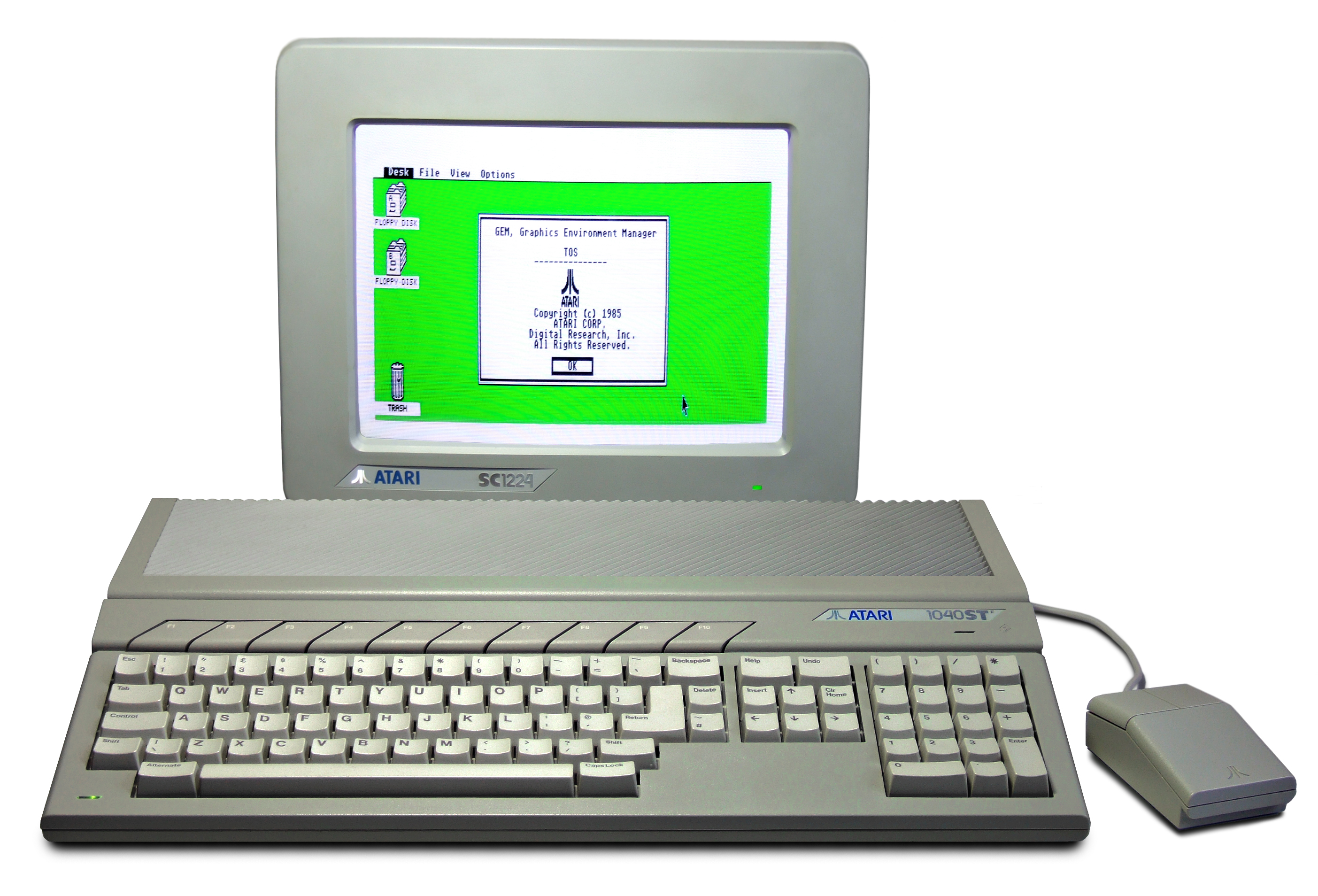
Atari 1040STF system photo: Bill Bertram, CC BY-SA 2.5, via Wikimedia Commons.
The Atari ST family — launched in 1985, and extended by the Atari STE in 1989 — paired a Motorola 68000 with a dedicated graphics/sound chip (the Shifter, later joined by STE's DMA sound and blitter) at a price that undercut the Macintosh and the Amiga alike. Like the Amiga, it drew a real community of paint, drawing, and animation software around it, much of it built on the ST's own low-resolution, 4-bitplane, 16-color screen mode.
Atari ST File Formats
The ST's fixed screen modes — low-resolution 320×200 at 4 bitplanes chief among them — gave every paint and animation program on the platform the same starting point, but GEM/TOS never had a shared container format the way IFF gave the Amiga one. DEGAS, NEO, Cyber Paint, and the rest each rolled their own file layout instead, almost always keyed directly to that same 320×200×16 geometry underneath. What's below is what survives of that decade of ST-native paint and animation software: still opened today by ST demoscene preservationists, emulator users, and retro-computing archivists digging up old disks.
Formats on This Page
| Format | Extension | Kind | Introduced |
|---|---|---|---|
| DEGAS & DEGAS Elite | .pi1–.pi3, .pc1–.pc3 | Bitmap | 1985 / 1986 |
| NEOchrome | .neo, .ani | Bitmap & animation | 1985 / 1986 |
| Cyber Paint (CEL & SEQ) | .cel, .seq | Bitmap & animation | 1987 |
| Spectrum 512 | .spu, .spc, .sps, .pcs | Bitmap (truecolor) | 1987 |
| GEM/GDOS Bitmap Font | .fnt | Bitmap font | 1985 |
| Icons and Program Art | .cpx, .ib3, .ibi | Icons inside programs | 1988 / 1990s |
Cyber Paint — CEL and SEQ
Cyber Paint was Jim Kent's paint-and-animation program for the Atari ST, published by Antic Software. It saved individual frames as CEL files and full animations as SEQ ("sequence") files, the latter built around a delta-compression scheme fast enough to play back full-motion animation straight off a floppy disk.
| Aspect | Detail |
|---|---|
| Developer | Jim Kent |
| Publisher | Antic Software (Antic Publishing) |
| Released | Version 1.0, 1987; Version 2.0, Summer 1988 |
| Platform | Atari ST and STE |
| Related program | Could load and edit animations from Cyber Studio (Tom Hudson's CAD-3D 2.0 bundled with Mark Kimball's Cybermate), whose own DLT delta format Cyber Paint's SEQ format improved on |
| Extensions | .cel (Cyber Paint Cell), .seq (Cyber Paint Sequence) |
History
Jim Kent had already written the delta-compression technique behind the Amiga ANIM format's Op 5 method, for Aegis Animator in 1985, and ported Aegis Animator itself to the Atari ST. His next ST program, Flicker — a simple flipbook animation utility, built in about a week — caught the attention of Gary Yost, who ran Antic's software-publishing arm and arranged for Flicker to run in Antic's START magazine.
Antic had separately published Tom Hudson's Cyber Studio CAD-3D, a 3D modeling and animation package, in 1986; a year later, CAD-3D 2.0 was bundled with Mark Kimball's Forth-based Cybermate authoring language as "Cyber Studio." Cybermate stored its animations as an external DEGAS base picture plus a chain of raw EOR-delta frames — the DLT format. Kent studied that delta technique and realized it could power a full 2D paint-and-animation program of its own, not just script CAD-3D renders. The result, Cyber Paint, stood on its own as a paint and animation tool and could also load and "doctor" Cyber Studio's own animations.
Cyber Paint shipped as Antic Software Version 1.0 in 1987; Version 2.0 followed in the Summer 1988 wave of Cyber-branded software, one of the last releases before Gary Yost left Antic to found the Yost Group. There, Kent carried the same delta-animation ideas into Autodesk Animator (1989) and Animator Pro (1991) for MS-DOS — direct evolutions of Cyber Paint, licensed to and published by Autodesk. Kent's own authorship stopped there: a Windows successor did eventually ship, Animator Studio in 1995, but as a ground-up rewrite for Windows 95 no longer developed by the Yost Group.
Cyber Paint's own SEQ format improved on Cybermate's DLT scheme: rather than storing whole-screen EOR deltas, it splits the screen into its four ST bitplanes and run-length compresses each one vertically, roughly doubling storage density while still decompressing faster than the data could be streamed off a floppy disk in the first place.
Legacy and Popularity Today
Neither format was ever formally documented outside Atari retro-computing circles — what survives is mostly community reverse-engineering and archive listings like AtariMania's. Original Cyber Paint animations still circulate among ST demoscene and animation preservationists; Jim Kent's own "Tesla" demo animation, made in Cyber Paint, is archived today on Werner Randelshofer's Atari animation collection. Kent himself left games behind for computational biology, becoming a researcher at UC Santa Cruz where he wrote BLAT and created the UCSC Genome Browser — the same career turn noted on this site's Amiga page, since it was the same delta-animation work, on two different machines, that led there.
Paintapp Support
Paintapp reads Cyber Paint Cell files as a single uncompressed Atari ST low-resolution (4-bitplane, 16-color) frame. Width and height are explicit in the header rather than assumed, so non-standard cell sizes are read correctly alongside full 320×200 screens, and both classic ST (3-bit RGB) and STE (4-bit) palette encodings are auto-detected.
Paintapp plays back Cyber Paint Sequence animations, including per-frame palette changes for color-cycling effects.
Links
- Cyber Paint — The Antic Cyber Graphics Software
- Cybermate (Cyber Studio) — The Antic Cyber Graphics Software
- Cyber Studio — Wikipedia
- Cyber Paint — Atari Mania
- Tesla — Jim Kent's Cyber Paint demo animation
- Cyber Paint Sequence — Just Solve the File Format Problem
DEGAS and DEGAS Elite
DEGAS was the Atari ST's first serious paint program, and by early 1987 a contemporary magazine review was calling it the platform's best-selling software, full stop — not just best-selling paint program.
| Aspect | Detail |
|---|---|
| Developer | Tom Hudson (working title: "HUDraw") |
| Publisher | Batteries Included, Richmond Hill, Ontario, Canada |
| DEGAS released | 1985 |
| DEGAS Elite released | 1986 — list price $79.95, or a $40 upgrade with the original DEGAS disk traded in |
| Extensions | .pi1, .pi2, .pi3 (uncompressed); .pc1, .pc2, .pc3 (PackBits-compressed, DEGAS Elite) |
History
Tom Hudson — the same programmer behind Cyber Studio's CAD-3D, above — wrote DEGAS for Batteries Included in 1985, shortly after the ST itself launched. DEGAS Elite followed in 1986, adding PackBits compression to shrink picture files, plus color-cycling animation data that could be saved right alongside a still picture in the same file.
Legacy and Popularity Today
"DEGAS has been the biggest-selling ST program to date," Antic magazine wrote in January 1987 — a striking claim for a paint program to hold against every other category of software on the machine, games included. Its chief rival for ST artists was NEOchrome, below, which had the advantage of shipping free with every ST. DEGAS pictures are still widely readable today: the actively maintained pixel-art editor GrafX2 loads and saves them natively, and XnView can open them with its full format list enabled.
Paintapp Support
Paintapp reads both plain and PackBits-compressed DEGAS pictures, across all three ST screen resolutions (low-res 16-color, medium-res 4-color, high-res monochrome), and a rare non-standard 320×280 low-res variant. DEGAS Elite's color-cycling animation ranges, when present, are read as well.
Pictures saved by other programs in DEGAS's own layout are read here too — Paintworks'
.sc1 among them, which is a DEGAS file under a different extension.
Links
- DEGAS (software) — Wikipedia
- Tom Hudson (programmer) — Wikipedia
- DEGAS Elite review — Antic magazine, January 1987
- DEGAS Elite — Atari Mania
- Atari ST Graphics File Formats — fileformat.info
NEOchrome
NEOchrome was Atari's own paint program, bundled free on the system disk of every ST rather than sold as separate software — most ST owners' first paint program, whether or not it stayed their favorite.
| Aspect | Detail |
|---|---|
| Developer | Dave Staugas, with programmer Jim Eisenstein and interface designer Jerome Domurat — all at Atari Corporation |
| Publisher | Atari Corporation — bundled with every ST, never sold separately |
| Released | An early v0.5 build shipped on the first STs' system disks in 1985; v1.0 was shown publicly at London's PCW Show in 1986 |
| Companion format | NEOchrome Animation (.ani), added from v0.9 — borrows its palette from a sibling .neo screen rather than storing its own |
| Extensions | .neo (NEOchrome), .ani (NEOchrome Animation) |
History
Dave Staugas, one of the programmers behind the ST's own TOS operating system, wrote NEOchrome together with programmer Jim Eisenstein and interface designer Jerome Domurat — who also drew the ST's system icons and fonts. An early v0.5 build was already on the system disks of the very first STs in 1985; NEOchrome reached version 1.0 and was demonstrated publicly at London's PCW Show in 1986. Atari never sold it as a separate product — it was simply part of what came with the machine.
From version 0.9 onward, NEOchrome could record its own animations too, saving them as a
companion .ANI file alongside a NEOchrome screen. The .ANI format
carries no palette of its own — it borrows the colors of whichever .NEO screen
it was recorded against.
Legacy and Popularity Today
Because NEOchrome came free with every ST, it stayed popular within the ST community "even in the face of more advanced packages such as DEGAS and Deluxe Paint," as Wikipedia describes it. A fan-made successor, NEOchrome Master, followed in 1992 from Chaos Inc./The Delta Force — crediting Tillman Bubeck alongside the original Staugas/Eisenstein/Domurat team — adding STE and Blitter support, multiple work-screens, and the ability to import DEGAS, IFF, and Doodle pictures alongside NEOchrome's own. Original NEOchrome releases and their file format are still catalogued today by retro-computing archives and demoscene sites like Demozoo.
Paintapp Support
Paintapp reads NEOchrome pictures — the fixed-size low, medium, or high-resolution ST
screen, its 16-color palette, and a color-cycling animation range when the file defines
one — and plays back NEOchrome Animation clips, reading their palette from a companion
.NEO file when one is present alongside it.
Links
- NEOchrome — Wikipedia
- NEOchrome file format — Atari Wiki
- NEOchrome Master — Just Solve the File Format Problem
- NEOchrome — Atari Mania
- NEOchrome Animation file format — AtariForumWiki
Spectrum 512
Spectrum 512 pushed the ST's 16-color hardware far past its intended limit, reprogramming the palette registers mid-scanline to put up to 512 different colors on screen at once — a genuine hardware trick, built into a paint program rather than just a file format.
| Aspect | Detail |
|---|---|
| Developer | Boris Tsikanovsky, of Trio Engineering Inc. (founded with his brother Michael Elman) |
| Publisher | Antic Software (Antic Publishing) — contract signed spring 1987 |
| Released | 1987 |
| How it works | The palette is reloaded up to three times per scanline, each reload drawing from the same 512-color universe (8 levels per RGB channel) — so one 320-pixel line can show up to 48 colors chosen from the full 512 |
| Companion products | DigiSpec (video digitizer capture), UniSpec |
| Extensions | .spu (uncompressed), .spc (compressed), .sps ("smooshed", heavier compression) |
History
Boris Tsikanovsky got an Atari ST in 1986 and built the palette-cycling engine behind Spectrum 512 at Trio Engineering, the Massachusetts company he had founded with his brother Michael Elman. Antic Software signed the pair in spring 1987 and published Spectrum 512 that year, squeezing far more color out of the ST than Atari's own 16-color limit implied was possible, by reprogramming the palette registers between pixels rather than once per frame.
Legacy and Popularity Today
ST-Log's August 1988 review said Trio Engineering had "taken the ST to limits of color
display never attained before," and UK magazines agreed — Amiga/ST Format gave it 4 out of
5 that same year. Steve Belczyk documented the format's decoder publicly in December 1990.
Modern support is mixed: GrafX2, which reads DEGAS and NEOchrome natively, doesn't support
Spectrum 512, though period tools and dedicated ST image viewers still do. Atari-Forum
hobbyists were still extending the format as recently as the 2020s, pushing an uncompressed
.SPU variant to 32,768 colors.
Paintapp Support
Paintapp decodes all three Spectrum 512 picture variants — uncompressed .SPU,
PackBits-compressed .SPC, and the more heavily compressed "smooshed"
.SPS — reconstructing the full per-scanline palette trick into a plain
truecolor image.
The same reader also handles PhotoChrome (.PCS), a later, separate program
that pushes the same idea further: two full frames, each with the palette trick applied,
blended together into one image for an even wider effective color range. Paintapp decodes
both single- and dual-frame PhotoChrome files, including their optional XOR delta-coding
between frames, and both classic ST and STE palette encodings throughout.
Links
- Spectrum 512 — The Antic Cyber Graphics Software
- Spectrum 512 review — ST-Log, issue 22, August 1988
- Spectrum 512 — MultimediaWiki
- PhotoChrome — MultimediaWiki
- Spectrum 512 file format — AtariForumWiki
GEM/GDOS Bitmap Font
The one format on this page that is not a picture. GEM fonts are what GDOS loaded and the VDI drew text with, so they are the typefaces behind ST desktop publishing and word processing — and they turn up in quantity on ST software collections, usually as a family of point sizes for one face.
| Aspect | Detail |
|---|---|
| Origin | Digital Research's GEM, whose font and device layer (GDOS) the ST inherited along with the rest of GEM |
| Header | 88 bytes: face name and point size, the character range, vertical metrics (top, ascent, half, descent, bottom), and offsets to the tables below |
| Glyph storage | One wide 1-bit strip, not a grid of cells — every glyph side by side with no separator, as many scanlines tall as the font |
| Proportional widths | A table of X positions in bits into that strip, one per character plus a terminator, so a glyph's width is the difference between consecutive entries |
| Byte order | Both occur in the wild — Motorola on the Atari, Intel on PC GEM. There is no flag that reliably distinguishes them, so the header has to be validated in each order to find out |
| Extensions | .fnt |
History
GEM arrived on the ST in 1985 as TOS's desktop, but GDOS — the part that loaded fonts and drove printers — was not bundled with early TOS releases and had to be added separately, which is why ST font files circulated as loose collections for years. The format long outlived that awkward start: it stayed the ST's bitmap font format through the platform's life, and the same layout served PC GEM, which is why the byte order varies.
Paintapp Support
Decoded and rendered as a specimen sheet — the glyphs laid out in a 16-column grid rather than as the single long strip they are stored as. Both byte orders are handled.
Note that .fnt is one of the most overloaded extensions in retro computing.
A GEM font is the only one with a real header; the others Paintapp reads under the same
extension — Atari 8-bit and Amstrad CPC character sets, and the raw 8×8 and 8×16 ST system
font dumps — are headerless blocks of glyph bitmaps identified only by their size. A GEM
font is recognized by validating its header instead, so the two do not collide.
References
Icons and Program Art
Not every ST picture was saved by a paint program. Two of the formats Paintapp reads are pictures that lived inside something else:
| Format | What it is | Paintapp support |
|---|---|---|
CPX/CPZ | An XControl control-panel module — a program, with a 512-byte header in front of it so the panel can draw the module's entry without loading it. That header holds a title and a 32×24 monochrome icon, which is what Paintapp shows | Icon decoded |
IB3/IBI | ICDRAW icons: 32×32 GEM icons in four bitplanes with a separate 1-bit mask. An .ib3 carries three states — normal, selected, and the same drawing in one bitplane for a monochrome screen | Decoded |
See Also
- File Formats — the complete format registry, with a "Browse by Platform" section covering Atari ST alongside every other supported platform
- Amiga — Jim Kent's other delta-compressed animation format, ANIM's Op 5 method